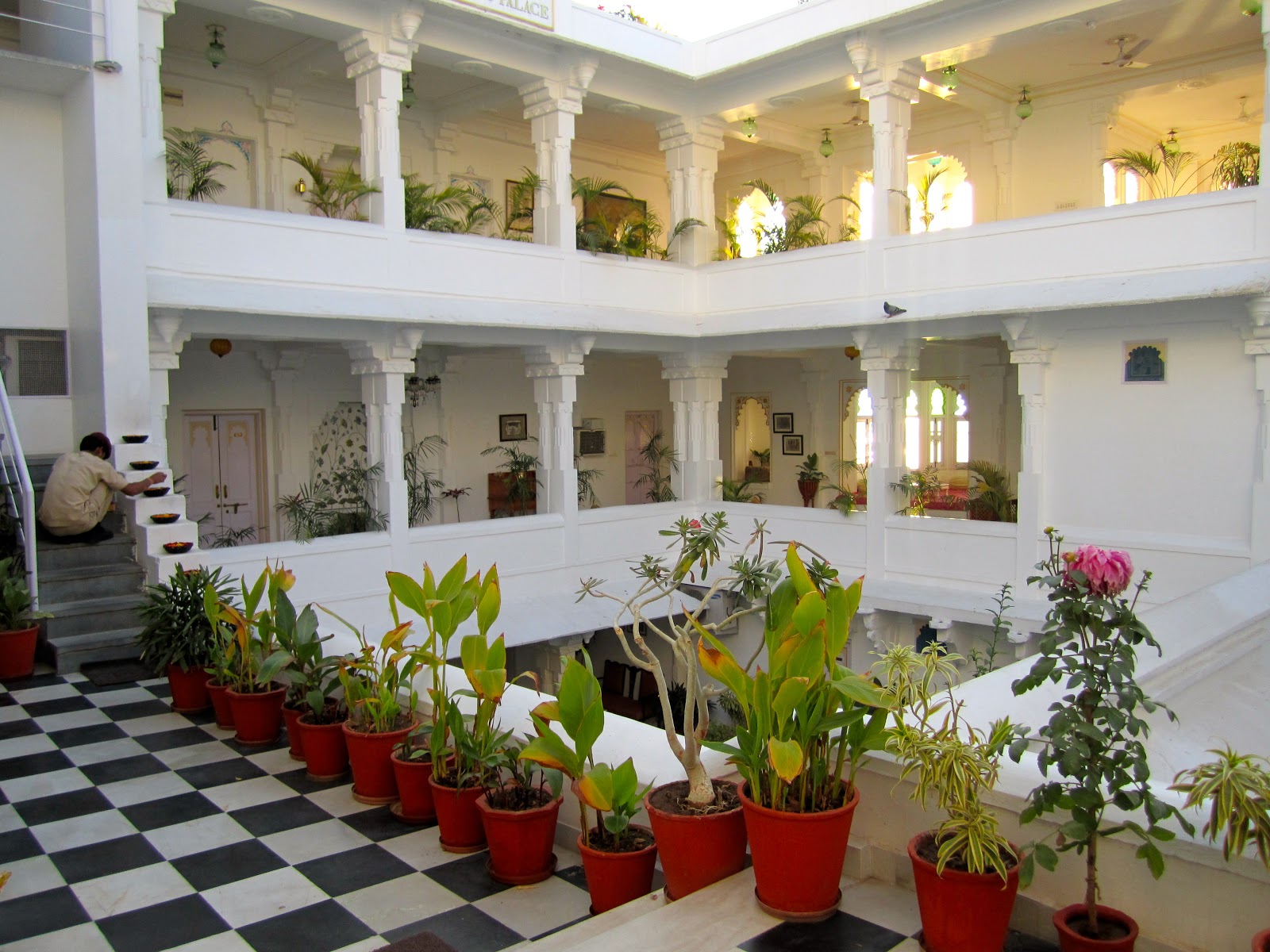
Udaipur, known as the city of lakes, was the next stop on our India tour and where we spent Christmas Eve and Christmas Day. We stayed at the
Jagat Niwas Palace hotel - which is now a heritage hotel but was originally built as a small palace in the 17th century. We stayed in a Pichola Suit which was right on the lake and beautifully decorated.
Click here:
360 of Jagat Niwas Palace Hotel sunset
360 of Jagat Niwas Palace Hotel daytime
360 of Jagat Niwas Palace Hotel rooftop
Kingsley's GoPro sunset over Lake Pichola
Beautiful rooftop view of the Lake Palace hotel in the center of the lake which is where one of the James Bond movies was filmed. And yes I did try to get reservations at the restaurant there but was firmly told the restaurant was exclusively for guests of the hotel. You win some you lost some...
Christmas morning breakfast - masala omelets, naan, and hot lemon tea.
Christmas sunset - couldn't have asked for a better gift!
Labels:
India,
Travel Adventures

Umaid Bhawan Palace is one of the worlds largest private residences. Half of the palace has been converted into a very exclusive 5 star hotel and the other half is still the private residence of the Royal family of Jodhpur. I have read so many amazing things about the palace and was desperate to find a way to check it out. But with room rates of over $10,000 per night there was no way we were going to be overnight guests.
My plan B was to book reservations in the palace hotel restaurant Risala. When I called to make a booking I was initially given a tentative reservation but we then received an immediate call back saying that the restaurant was reserved for hotel guests only and was fully booked. At that point I was disappointed but ready to give up on the idea of checking out the palace. But it was Christmas Eve and Kingsley was determined to get us there. So we had the driver drop us off near the front security entrance gate of the hotel. I think the security guards were a little shocked to see us walking up to the grand entrance claiming to have reservations in the hotel restaurant as fancy chauffeured rolls royces with tinted windows glided by. There was a few frantic calls to management and a detailed inspection of Kingsley's Singapore ID card but in the end, I suspect with no better idea of what to do with us, they let us proceed to the restaurant.
Click here:
The inside of the hotel was as spectacular as I had imagined it to be. And the meal we had at Risala restaurant (in which we were one of the ONLY guests) was one of our top 10 best meals ever and our #1 best Indian meal ever.
Never mind that Kingsley was wearing his old ragged paragliding jeans and a bright blue Hawaiian crazy shirt and I was wearing long johns under my Lucy cargo pants...we felt like Royalty!
Loved the Christmas decorations in the grand lobby.
Oreo cheesecake
Homemade lychee sorbet
Beautiful gardens
Labels:
India,
Travel Adventures
From the vantage of the Mehrangarh Fort we had a great view of Jodhpur and a better understanding of why it is also known as the blue city.
It is thought that Brahmins – members of the priestly class – first took to coloring their houses blue (indigo) to signify their domicile and to set them apart from the rest of the population. Soon, however, the rest of the population followed suit. History does not tell us which brave non-Brahmin was the first to do it, yet it happened and since that day the people of Jodhpur have steadfastly maintained this tradition.
Ask a local why all the houses are painted thus and the usual reply is that the color keeps the interiors cool and fends of mosquitoes. Yet if this truly worked then it would be quite likely that the whole subcontinent would be awash in various hues of indigo.
Labels:
India,
Travel Adventures
Mehrangarh Fort, one of the largest forts in India, was built in 1459 AD by Rao Jodha.
Rao Jodha (1438–1488), one of Ranmal's 24 sons became the fifteenth Rathore ruler. One year after his accession to the throne, Jodha decided to move his capital to the safer location of Jodhpur as the one thousand years old Mandore fort was no longer considered to provide sufficient security.
The foundation of the fort was laid on May 12, 1459 by Jodha on a rocky hill 9 kilometres (5.6 mi) to the south of Mandore. This hill was known as Bhaurcheeria, the mountain of birds. According to legend to build the fort he had to displace the hill's sole human occupant, a hermit called Cheeria Nathji, the lord of birds. Upset at being forced to move Cheeria Nathji cursed Rao Jodha with "Jodha! May your citadel ever suffer a scarcity of water!". Rao Jodha managed to appease the hermit by building a house and a temple in the fort very near the cave the hermit had used for meditation, though only to the extent that even today the area is plagued by a drought every 3 to 4 years. Jodha then took an extreme measure to ensure that the new site proved propitious; he buried a man called Rajiya Bhambi (a Meghwal) alive in the foundations. Rajiya was promised that in return his family would be looked after by the Rathores. To this day his descendants still live in Raj Bagh, Rajiya's Garden, an estate bequeathed them by Jodha.

Phool Mahal - Flower Palace
Moti Mahal - Pearl Palace
Entry into Singhar Chowk (courtyard)
An elephant palanquin
Inside Flower Palace
Within the fort there are several brilliantly crafted and decorated palaces. Of these I found, Moti Mahal (Pearl Palace), Phool Mahal (Flower Palace) the most impressive.
The very serene video footage below was taken right before a bird pooped on my camera and mass chaos ensued.
Labels:
India,
Travel Adventures
The city of Jodhpur was the next stop on our trip and the last stop of the overnight train which finally crept into the city at 9:30pm - 9 hours after we boarded the train. Though we were starving and in desperate need of a clean toilet and shower we were thankful to have arrived safely.
Jodhpur, also known as the "sun city" due to the bright sunny weather throughout the year, is the second largest city in Rajasthan.
View of the Mehranghar Fort from the rooftop of our hotel - the Haveli Pal Inn.
Click below:
The haveli inn is a heritage hotel and in the 18th century was the private residence of the aristocratic family of the fiefdom Pal. The home has stayed in the family and Chamund Singh Pal and son Narpat Singh Pal had the home tastefully converted into a Heritage hotel. The main lobby is filled with photos and paintings of the family lineage.
Picture above:
The two bottom pictures are the current owners. The upper photos are the father and grandfather.
Picture below:
from right to left great-grandfather, great-great grandfather, great-great-great grandfather....ect.
We found the owners to be incredibly hospitable. Even opening the kitchen for us after it had closed for the night so we could have a decent meal. I also loved asking them about the family history and have to admit I was pretty impressed with the familial pride and intricate details they knew about their family history. I don't have to go very far back in mine to know very little other than the names and dates on the family tree.
Labels:
India,
Travel Adventures
After a few days of exploring and relaxing in Agra we were scheduled to take the overnight train to Jodhpur (apx 10hour train journey). The train was scheduled to leave at 7:30pm but after our Delhi to Agra "train incident" we were both a little wary that it might be delayed and sure enough we were right! We had the hotel front desk call the station for us and found out our train was delayed due to FOG... AGAIN! We were initially told it would be arriving at midnight which then turned to 4 am, then 8 am, it finally arrived at 11:30am! Thankfully the hotel had a room available for us so we were able to spend the night in bed vs the train station benches. Gotta be thankful for the little things in these situations! After a quick Orient Taj Palace breakfast at the hotel where I shamelessly took all the rolls from the bread basket for our train trip we left for the train station. We arrived around 8:30am thinking we would hop right on the train but ended up having to wait 3 more hours for the train to arrive.
Our time in the station was fascinating, freezing, horrifying and captivating all wrapped into one. I'm glad we got to experience it but I'm still trying to process all the things we witnessed in those 3 hours. Men heading to work carrying plastic bags instead of briefcases, a woman wearing no shoes chatting on a cell phone, people begging sometimes but mostly just drifting, and almost everyone stopping to blatantly stare at us two misfits sitting on the train bench.
Waiting not-so patiently on the platform for the train to arrive.
We finally made it on the train to our sleeper cabin which is not actually a cabin but an incredibly narrow bunk bed seat with a curtain that closes around it Which is where we spent the next 10 hours...surviving on almonds and the swiped bread from breakfast. Thank goodness for my kindle and its super long battery life. I read two and half books on the train while Kingsley mostly slept. I envy his ability to sleep almost anywhere.
Forget fog - this is the number one reason why I hope to never ride on another train in India again! After my first visit to the train toilet I immediately began rationing my water intake for the rest of the journey.
Found this report in the newspaper about a week after our train ride.
Labels:
India,
Travel Adventures
Agra Red Fort was designed and built by the great Mughal ruler, Akbar, in about 1565 A.D. It was initially built as a military establishment but later on his successors made many additions to the main structure. Several Mahals , which were built afterwards, converted half of the structure into a magnificent palace.
The Red Fort is situated in Agra, on the banks of Yamuna River. It is known as Red Fort because it is built of a kind of red sandstone.
The fort has been in continuous use as a military defense since (at least) the 11th century A.D. Even today, about three quarters of the fort is occupied by forces of the Indian Army.
Diwan-i-Aam
This impressive hallway and courtyard beyond originally served as the courtyard of the Diwan-i-Aam, the large pavilion for public imperial audiences with an ornate throne-balcony (jharokha) for the emperor. The columns were painted in gold and there was a gold and silver railing separating the throne from the public.
Click below to see a full view of the Diwan-i-Aam.
Labels:
India,
Travel Adventures