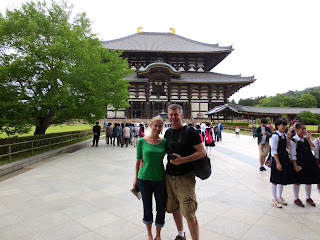
Kingsley and I rented bikes (800 yen/day) for the day to explore Nara. We had so much fun peddling along the tiny pedestrian street stopping along the way to visit a few of the beautiful gardens and temples and of course for me the major attraction was to feed the deer.
Our bike route map. We rode from the bottom left corner (Matsumae Ryokan) of the map to the upper right (Todaiji temple).
Another snapshot from my childhood. I remember loving the deer park but also being a tiny bit afraid of the deer. The only thing that has changed 20 years later is the deer seem a little bit smaller!
Feeding deer in Nara
Established in 1880, the park is home to hundreds of freely roaming deer. Considered in Shinto to be messengers of the gods, Nara's nearly 1200 deer have become a symbol of the city and have been designated a natural treasure.
The deer are surprisingly tame, although they can be rather mischievous if they think you will feed them or are hiding food from them. One of the deer kept nibbling on my shirt when I was ignoring it to feed other deer.
Deer crackers are for sale around the park for about 150 yen for a pack of 10 crackers. Some deer have learned to bow to visitors asking to be fed which provided me hours of entertainment.
In the video below I am not sure who was more photographed the deer or myself!
Nara was the capital of Japan from 710 to 784. The Kofukuji temple was built in 710 and was the family temple of the Fujiwara, the most powerful family clan. The wife of Fujiwara built the temple, wishing for her husband’s recovery from illness. The pagoda is the second tallest in Japan. At 50 meters, the five story pagoda is Japan's second tallest, just seven meters shorter than the five story pagoda at Kyoto's Toji temple.
Todaiji Temple in Nara is an awe-inspiring sight and in my opinion should be at the top of any sightseeing trip to Japan. The temple was built in 752 during the Nara period (710 – 794 AD) the name Todaiji means Great Eastern Temple, and it was built to be the head temple of all provincial Buddhist temples in Japan.
Todaiji’s Daibutsuden Hall (Hall of the Great Buddha) is the largest wooden building in the world. It is truly impressive, but even more amazing is the fact that today it is only two-thirds the size of the original building. The current building dates from 1709 when it was rebuilt. The Great Buddha is one of the largest bronze figures in the world. It was originally cast in 746, and the present statue was recast during the Edo period. It stands at just over 16m high and contains 437 tons of bronze and 130kg of gold.


Labels:
Japan

Kingsley and I are massive tea drinkers when we are at home. I especially love green tea so no trip to Japan would have been complete without participating in a traditional tea ceremony.
Ceremonial tea drinking was brought to Japan by Zen Buddhist monks in the 1200's. These monks developed a simple and precise ceremony that has lasted several centuries. The ceremonial serving of tea used to be exclusively practiced by nobles and priests around the middle of the fourteenth century. Until the end of the Edo period (1603-1868) it was practiced almost entirely by men; women joined in only after the beginning of the Meiji era (1868-1912).
Through this experience I learned that the tea ceremony is much more than an elaborate ritual to prepare a cup of tea, it is a quiet interlude during which the host and guests strive for spiritual refreshment and harmony with nature. The setting of the ceremony should be simple, calm and meditative; it seeks to purify the mind and attain oneness with nature.
As tea ceremony novices our basic role for taking part in the Japanese tea ceremony involved sitting quietly and tasting a small sweet offered by the host, who then prepared a (quite large) bowl of frothy green tea for us.
The structure and atmosphere of a Japanese teahouse are designed to focus one's attention on the present moment and promote a feeling of being away from the concerns of the everyday world.
Our small sweet offering - black sesame cake for me and a black sesame gelatin for Kingsley - neither of which were actually very sweet.
We were also presented a booklet filled with pictures of tea cups that we were told to browse through and select our specific cup for the ceremony. I am sure each cup had a long history and significant meaning behind it but we just chose two tea cups that we thought looked "cool". The tea ceremony lady seemed particularly impressed by Kingsely's tea cup selection.
The tea for a Japanese Tea Ceremony called Matcha is green and thick and tastes very bitter. It is brewed over a charcoal fire and poured into large cups without handles. We learned (after the fact) that the sugary candy that was placed on our table was meant to be eaten before taking a sip of the tea in order to sweeten the taste. We also learned that a good guest will make a slurping sound with their tea to indicate that they enjoy it. Knowing these two facts in advance would have been helpful but I think we managed to complete the ceremony without offending anyone too badly.
"Those participating in the tea ceremony should sip their tea quietly and keep their conversation formal and short. Their focus should be on the movements of the server, the beautiful surroundings and the marvelous taste of the tea."
Kingsley (silently) drinks his tea...oops
Labels:
Japan
As part of our cultural enrichment while in Japan, I signed us up for Calligraphy lessons with Naomi at Ryokan Matsumae. Naomi is an incredibly talented dancer, musician and artist and was a fantastic teacher. We first learned that one must hold the calligraphy brush like it is a chopstick not a pencil. We also discovered that posture and arm poise are important to creating beautiful Japanese characters but that having a "zen" mind was the most critical component.
Japanese philosopher Nishida Kitaro (1870-1945) stated:
True creativity is not the product of consciousness but rather the "phenomenon of life itself." True creation must arise the state of "no-mind," in which thought, emotions, and expectations do not matter. Truly skillful Zen calligraphy is not the product of intense "practice;" rather, it is best achieved as the product of the "no-mind" state, a high level of spirituality, and a heart free of disturbances.
To write Zen calligraphic characters that convey truly deep meaning, one must focus intensely and become one with the meaning of the characters they create. In order to do this, one must free his/her mind and heart of disturbances and focus only on the meaning of the character. Becoming one with what you create, essentially, is the philosophy behind Zen Calligraphy and other Japanese arts.
Our final work, we each chose a word to write (from left to right): Lynn - patience, Kingsley - exceptional, Dad - harmony, Mom - joy. My Dad and Kingsley showed the best natural calligraphy talent. They obviously found a way to channel their inner zen. I obviously still have a lot to learn about freeing my mind and heart from disturbances.
Labels:
Japan
After a week up in Nagano we headed south and took two bullet trains and several local trains to arrive in Nara. My family lived in Nara for about 3 years in the late 80's so I was excited to visit again.
Kingsley waiting for a local train...hmmm what is wrong with this picture??
Our hotel room
In Nara we stayed in a traditional Japanese hotel called
Ryokan Matsumae which was run by a wonderful Japanese woman Naomi. She was an incredibly gracious host which made our stay at the beautiful Ryokan so memorable.
Arriving for breakfast in our traditional yukata's (bathing clothes). In our room there was a little info packet which explained how to properly wear the yukata. It is important to place the left section over the right section as right over left is only used when dressing a body for a funeral. Of course my wonderful Mother somehow forgot this rule and to the shock and horror of the hotel staff and other guests, arrived for breakfast "dead".
Another important rule is to never wear your indoor slippers or shoes on the tatami mat floors. Upon arriving at breakfast Kingsley managed to get about halfway across the tatami floor before one of the staff noticed and frantically began waving their arms and pointing at his feet saying "NO...NO!" I think its safe to say we were not the most cultured guests they had ever had, but at least we kept things lively.
For bfast my parents ordered traditional Japanese and Kingsley and I tried the American style which Kingsley was thrilled to discover included a very large scoop of strawberry ice cream.
Labels:
Japan
Jigokudani Monkey Park was created in the early 1960's after a curious female macaque dipped her hand in the hot spring water and realized it was quite comfortable bathing in a hot tub during the snowy winter months. A man-made onsen was created for her macaque troop and the "snow monkeys" of Yudanaka were born.
The Japanese Macaque is a monkey species native to northern Japan, and is the most northern-living non-human primate, surviving winter temperatures of below -15 °C. They have brown-gray fur, a red face, hands and bottom, and a short tail - and often seem remarkably human like.
The monkey park is located in Jigokudani, which translated means Hells Valley, due to the steep cliffs and hot water steaming out from the earth's surface. It's a fairly harsh environment in winter with snow on the ground for a third of the year, but it is also a paradise for the snow monkeys who live there and are unique that they are the only known monkeys that bathe in hot springs.
I was a little worried that visiting the monkey park in the spring would mean we would see little to no monkeys in or around the hot springs but that was not the case. Also May is a beautiful time to visit as all the new babies have just been born and are incredibly adorable.
Like most monkeys, the Japanese macaques live in a matriarchal society, with just a smattering of males per troop. Every individual has their place and a strict hierarchy is adhered to at all times.
It is about a thirty minute hike (uphill) to visit the snow monkeys but well worth the walk through the beautiful forest.
Labels:
Japan
On our second paragliding attempt, we drove back out to Aoki hoping for good wind conditions. We were told the wind was not too good at Aoki but there was a location about 45 min away that was flyable. So we jumped back into our rental car and followed a van full of Japanese Paraglider students through the back roads of Nagano to a different (more flyable) mountain. After spending quite some time studying a local map I determined this second location was either at or nearby the Mizutori Park between Ikeda and Ikusaka (45 min west of Aoki).
A beautiful training hill and mountain to fly off.
When we finally arrived at the top of the mountain the wind conditions had become slightly "not ideal". They were getting a little gusty and turbulent however, there were a few other gliders in the air that seemed to be doing just fine. So Kingsley made the decision to launch and had an brief but very exciting (partial wing collapse) flight.
Kingsley, after years of dreaming about it finally flew in Japan.
Kingsley handled the rocky flight just fine but was not desperate to fly again after all that adventure and no other pilots launched after they saw how Kingsley's flight went. So we said goodbye to our new Japanese paraglider friends and drove along the river till we found a nice spot for (yet another) paragliders picnic of tuna, crackers and cheese. I'm sure by this point my parents were pretty tired of tuna and crackers, though they never once complained.
Overall the day was a success. It was another beautiful day in the mountains of Japan and we had a lovely time just being together driving along and exploring tiny farms and villages.
Labels:
Japan
During our week up in Nagano we only had one day of rainy, foggy, cold weather. We made the best of the day and took a 2 hour road trip out to the Japan Sea. Thankfully Kingsley is a great driver and handled navigating the fog without a problem.
This slightly nervous backseat driver was either trying to find her happy place or in time-out as we drove through some significant foggy patches.
The Goetsch and Wood family at the Japan Sea
We stopped for lunch at a small hotel/fish market right on the Japan sea. The seafood was certainly incredibly fresh but there were some interesting options on our lunch plates.
Very fresh snails and baby octopus both of which might have still been alive. My Dad was the only one brave enough to eat them!
Labels:
Japan